



















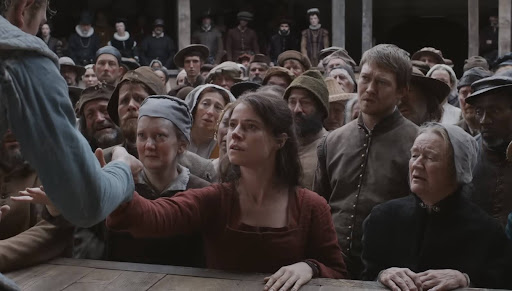
Based on the 2020 novel by Maggie O’Farrell, “Hamnet,” directed by Chloé Zhao, hit theaters on Nov. 26.
Although well known for her poorly received Marvel film “Eternals” (2021), Zhao managed to reaffirm her title as an Academy Award-winning director through her most recent film.
The film opens on a title card which replicates the epigraph at the beginning of the novel and notes that the names Hamlet and Hamnet were used interchangeably in Stratford, England, during Shakespeare’s time.
This title card is followed by the first meeting between Agnes Hathaway (Jessie Buckley) and William Shakespeare (Paul Mescal), the Latin tutor to Agnes’ younger brothers.
It is during one of their meetings that Agnes reveals to William that she has the ability to see into people’s futures, including her own, where she sees herself dying with two children at her bedside.
Despite their union being discouraged, the two eventually marry and soon have their first child, Susanna (Bodhi Rae Breathnach).
Although the two were able to maintain a life in Stratford, Agnes realizes that William needs more out of life and encourages the idea that he should go to London to pursue his writing, leaving her at home while pregnant with her second child.
Though she wanted to give birth in the woods just as she did with Susanna, the weather forced Agnes to give birth in her home. Expecting one child, Agnes gave birth to twins Hamnet (Jacobi Jupe) and Judith (Olivia Lynes), with the latter initially appearing stillborn but ultimately surviving.
The film then skips forward a few years after the birth of the twins to when the family has fallen into the routine of William going away to London, though his departures are still riddled with tears.
It is during one of these trips that Judith falls ill with the plague and that Hamnet trades places with her, stating that he will trick death so that it takes him instead of her.
Though Hamnet lives a short while longer, scenes of his treatment are blended with scenes of him in some sort of afterlife.
Upon his return, William discovers his son’s body, furthering the growing strain between him and Agnes. Shortly after, William heads back to London, where he prepares for his upcoming tragedy, “Hamlet.”
Back in Stratford, Agnes and the rest of their family are made aware of William’s play, to which Agnes travels to London with her brother Bartholomew (Joe Alwyn) to see the performance.
Although initially upset at the use of her son’s name in the tragedy, Agnes comes to realize the work was intended as a way to pay homage to Hamnet.
The film closes with Agnes and William sharing a look of ease and Agnes laughing, hinting at their relationship being rebuilt and the first steps towards moving on.
“Hamnet” shines a light on some of the functions historical fiction tackles. Despite the film and the novel adding and altering some details about Shakespeare and Anne Hathaway’s lives, historical fiction works like “Hamnet” help promote curiosity and imagination in audiences and encourage them to consider the balance between fact and fiction.
Although mysticism is used as a major plot device in “Hamnet,” it’s simply used to maintain audience interest and emphasize certain conflicts in the film, rendering it harmless.
By opting to change Anne Hathaway’s name to “Agnes” in the novel and film, the writers manage to steer clear from confusion with the actress and highlight that the names “Anne” and “Agnes” were used interchangeably at the time.
Like most modern media that attempts to depict real events, “Hamnet” uses fictionalized dialogue to dramatize the plot but also to fill in gaps that are prominent with regard to Anne Hathaway and her relationship with Shakespeare.
This necessary step of fictionalizing the dialogue between Hathaway and Shakespeare helps propel the major themes of grief, gender and family while also encouraging the audience to consider how Shakespeare’s career and popularity affected the lives of his wife and children.
The smaller arguments between Shakespeare and Hathaway, such as when they plan to get married and where they plan to live, help make their characters relatable to a modern audience and the significant arguments regarding Hamnet’s death and William’s presence at home helps introduce the audience to the considerable impacts that came with Shakespeare’s fame.
Although in real life it is unclear if Shakespeare was able to attend Hamnet’s funeral, the film attributes Shakespeare’s inability to witness his son’s final moments to him being in London. This detail once again guides the film’s audience toward the aforementioned topic.
Though whether Shakespeare wrote “Hamlet” as a tribute to his son is up in the air, “Hamnet” presents this possibility in an accessible way to all audiences.
Historical fiction has the potential to make history entertaining and introduce audiences to new topics, just as “Hamnet” has with the lives of Shakespeare and Anne Hathaway, as well as the plot of the tragedy “Hamlet.”