












Cutting down the net has been a tradition for national champions since 1947, becoming one of the many iconic symbols that March Madness has produced over the past 85 years.
This unique bracket-style tournament, featuring 68 teams, drew 18.1 million viewers for the national championship game alone last year. How will it perform nationally this season?
There are many aspects to consider when discussing March Madness, including the wacky terms, filling out the brackets, hundreds of them and even potentially betting on games.
Come one, come all — casuals, pros and even people who have no clue what college basketball is. Let’s have some fun! In this piece you’ll find the glossary of March Madness, with every single nerdy term explained, along with how likely it is to complete a perfect bracket.
The March Madness Glossary
At-large bids
The remaining 37 at-large bids are awarded to teams the NCAA selection committee deems deserving of a tournament spot. This process is revealed annually on Selection Sunday. In 2026, the event was held on March 15 to determine the official tournament bracket.
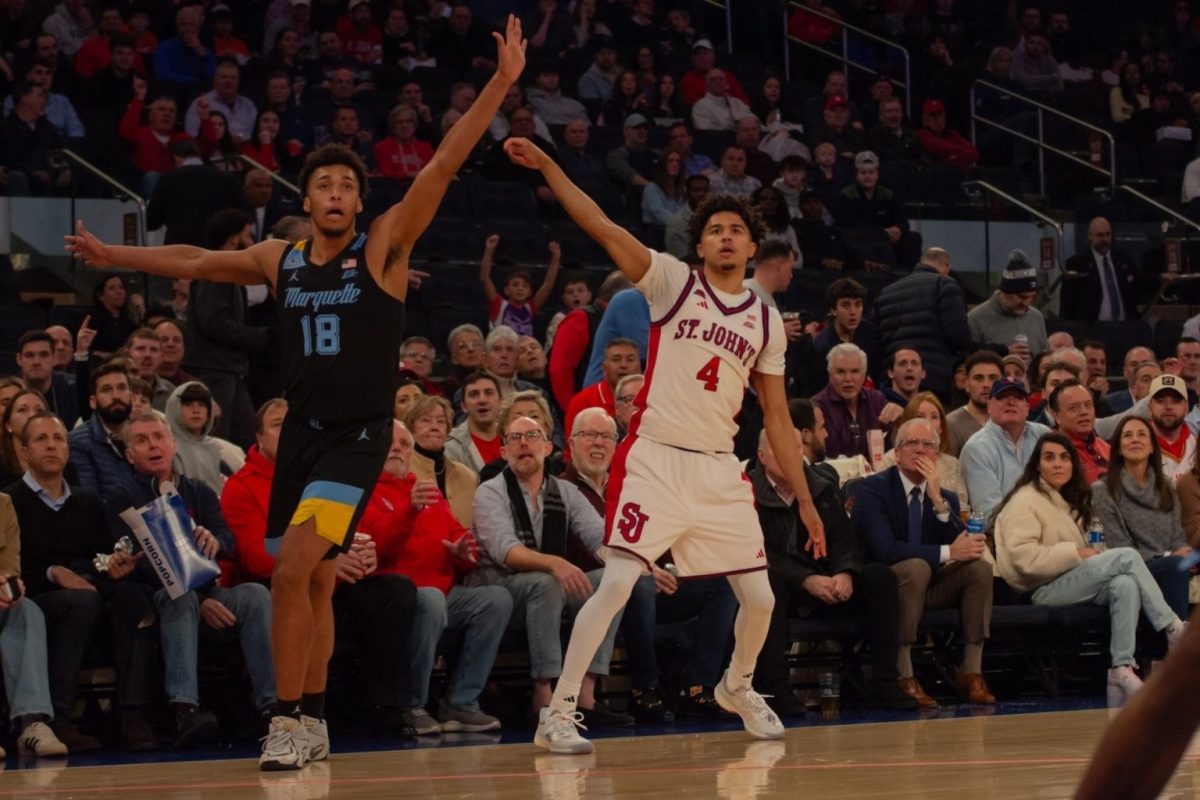
St. John’s will be a No. 5 seed, facing No. 12 Northern Iowa on March 20 at 7:10 p.m.
Auto Bids
The NCAA awards bids to the national tournament through two methods. A total of 31 bids, known as automatic bids, are guaranteed to the winners of each Division I conference.
Big Dance
The phrase was coined in 1977 by Al McGuire, the head coach of Marquette. After his team won a game to qualify for the tournament, he told a reporter, “You gotta’ have a blue blazer to go to the big dance.” Marquette went on to win the national title that year, and the name stuck as a metaphor for the glamour and prestige of the tournament.
Bracket
In the context of March Madness, the bracket is a tree diagram that visualizes the path all 68 teams must take to the National Championship. The bracket is divided into four regions: the East, West, Midwest and South.
Bracket Buster
In March Madness, a Bracket Buster refers to an underdog team that pulls off a major upset — one that ruins several million brackets throughout the country.
Bracketology
Bracketology, a term created by Joe Lunardi in his “Blue Ribbon College Yearbook,” refers to the practice of predicting the participants and outcomes of a tournament, particularly the NCAA college basketball tournament.
Bubble
A team would be considered “on the bubble” if they are on the verge of either making or missing the tournament. Usually, the bubble teams will be the last four in, teams that didn’t win their conference tournaments looking for an at-large bid.
Chalk
The heavy favorite in a matchup, or the act of picking higher-seeded teams throughout your bracket.
Elite Eight
The Elite Eight refers to the final eight teams remaining in the NCAA tournament. This round consists of the Regional Finals, where the winners of the Sweet 16 face off to determine who advances to the Final Four.
Final Four
The Final Four is the penultimate round of the NCAA tournament, featuring the champions of the four regional brackets (East, West, South and Midwest). These four teams meet at a single neutral site for the national semifinals, with the winners advancing to the National Championship game.
First Four
The four play-in games that officially kick off the NCAA tournament, are typically held on the Tuesday and Wednesday following Selection Sunday. These games determine the final four teams that advance to the main 64-team bracket.
KenPom
KenPom refers to the college basketball analytics and ranking system created by statistician Ken Pomeroy. It is widely considered the industry standard for predictive modeling in college hoops and is used by fans, bettors and even the NCAA Selection Committee to evaluate team strength.
Mid-Major
In college basketball, mid-major refers to teams and athletic conferences that fall outside the high-resource “power” conferences. While the NCAA does not officially use the term, it is the primary way fans and media categorize roughly 25 to 27 of the 31 Division I conferences.
NET Ranking
The NET ranking is the metric used by the NCAA to determine which college basketball teams qualify for the national tournament. It is based on several factors, including strength of schedule, offensive rating and defensive rating.
“Onions!”
“Onions!” is the signature catchphrase of legendary broadcaster Bill Raftery. He uses it to describe a player who makes a “gutsy” or high-pressure play, usually a late-game shot or a difficult bucket in traffic.
Seed
In March Madness, a seed is the numerical ranking assigned to a team (from 1 to 16) within one of the tournament’s four regions.
Sweet 16
The Sweet 16 refers to the regional semifinal round of the NCAA tournament, consisting of the final 16 teams remaining in the field
Quad Wins
Quad wins are divided into four quadrants, categorizing teams based on their NET rankings. A Quad 1 win is the most valuable, earned by defeating a team ranked 1-30 at home, 1-50 at a neutral site or 1-75 on the road.
The Odds of creating a “Perfect Bracket”
One of the most improbable feats in sports is creating a perfect March Madness bracket. The chances of achieving this are 1 in 9.2 quintillion, assuming every game is a 50/50 coin flip. Because of how unlikely this is, Warren Buffett has famously offered $1 billion to anyone who creates a perfect bracket — a prize that has yet to be claimed.
The closest anyone has come was in 2019, when an Ohio man predicted 49 straight games correctly, entering the Sweet 16 with a perfect bracket. Will someone finally crack the code and complete the coveted “perfect bracket” this year?
So, here are some things that are more likely to happen than creating the perfect bracket.
- Guessing a specific grain of sand: There are an estimated 7.5 quintillion grains of sand on Earth. You are 23% more likely to randomly pick one specific grain out of all the sand on the planet than you are to pick a perfect bracket.
- Winning the Powerball twice: You have better odds of winning the Powerball jackpot with two consecutive tickets than you do of achieving a perfect bracket.
- Finding a 10-leaf clover: A 4-leaf clover is 1 in 10,000. Finding a 10-leaf clover (the world record is 56) is mathematically more probable than 63 correct basketball picks.
- Finding a specific acorn: There are roughly three trillion trees on Earth; you are three million times more likely to randomly find one specific acorn hidden in one of those trees on your first try.
- Lightning & Sharks: You are 15,000 times more likely to die from a shark bite and 4 million times more likely to be struck by lightning than to pick a perfect bracket. You are even more likely to be struck by lightning twice (1 in 19 million).
- Vending machine accidents: You are more likely to be killed by a falling vending machine (1 in 112 million) than to go 63-for-63.
- Bowling a 300 game: For an average bowler, the odds are about 1 in 11,500. You could bowl nearly a million perfect games before you’d statistically expect to see one perfect bracket.
- Becoming a Movie Star: 1 in 1.5 million.
- Becoming an Astronaut: 1 in 7.7 million.
- Becoming President of the United States: 1 in 32.6 million.
- Giving birth to sextuplets: 1 in 3.9 billion.
- A family of four all getting hit by lightning: Statistically more likely than one person picking a perfect bracket
- Hitting two holes-in-one in the same round: 1 in 67 million.
- An average pitcher throwing a “perfect game” in the MLB: Roughly 20,000 to 1.
- Being dealt a Royal Flush: 1 in 649,739
