
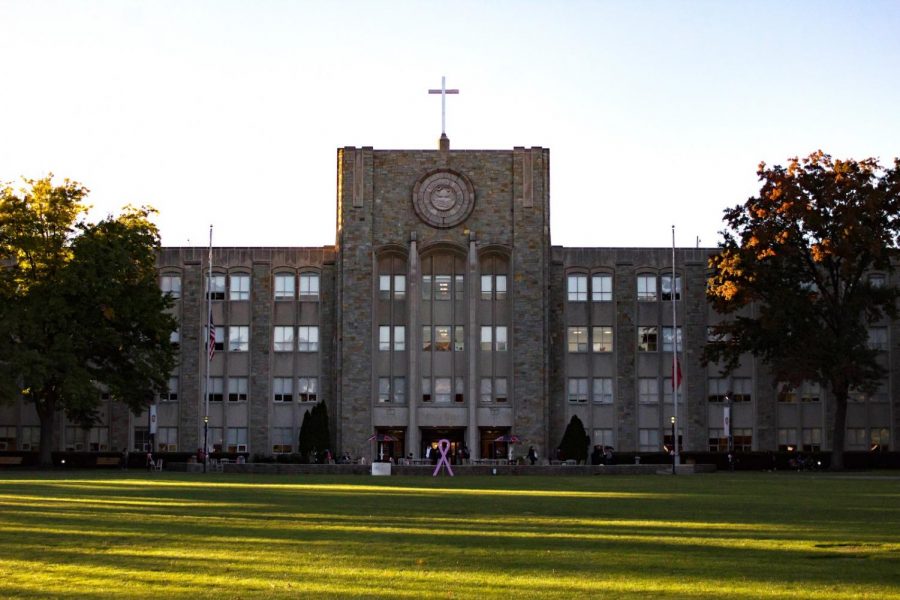











In a second-floor conference room in Bent Hall, students from the Peter J. Tobin College of Business waited Wednesday night as the clock inched closer to an event months in the making.
The “Come to the Table” Banquet on April 29 was the culmination of a semester’s worth of marketing and fundraising from students at Tobin for their “Shelter in the Storm” initiative. The initiative hosted campuswide bake sales and community events aimed at supporting New Yorkers experiencing homelessness.
The initiative was formed in partnership with Covenant House, a nonprofit that has provided relief to people experiencing homelessness in 34 cities across the United States, Canada and Latin America.
Students worked under the guidance of Jeff Taylor, a veteran professor of sports marketing and other marketing courses at the University, whom students affectionately call “Coach.”
Taylor, who is retiring this year, said he gave his students several options for the project, which has long been used as a practical assignment in experiential marketing.
“I gave them an option of a fun, sexy campaign like Nike, McDonald’s or Coca-Cola, and then I talked to them about Covenant House,” Taylor explained during an interview with The Torch.
“100% of students didn’t know what Covenant House was until we took on this project,” Taylor said jokingly. “But by the end of the night I think you’ll be able to see how they’ve embraced it, and how they’ve enjoyed it and learned from it.”
The banquet, which ran from 6-to-8 p.m. Wednesday night, consisted of statements from the “Shelter in the Storm” team, videos from Covenant House and a guest speaker.
Guest Speaker’s Story of Homelessness
Christine Kumbatovic spoke with a voice of experience as she detailed her struggles with addiction, abuse and homelessness.
“They kicked me out of the house, even though it was a really hard thing to do,” Kumbatovic said of her parents during her speech.
According to Kumbatovic, the decision came after her parents learned she had been charged with driving while intoxicated as a minor.
But the road to homelessness for Kumbatovic started years prior. According to the event’s guest speaker, her struggles with substance abuse stemmed from early childhood trauma and a desire to be accepted by her peers during her high school years.
During the first few weeks of her freshman year of college, Kumbatovic lost a close friend from high school. During the grieving process, she began using alcohol as a form of self-medication.
In search of a better way to cope with the grief, Kumbatovic turned to doctors, who prescribed her benzodiazepines to treat anxiety and depression. But like many others who received the same prescription, she found herself hooked on the medicine that was supposed to help her.
By the time she found herself kicked out of the house, Kumbatovic started spending time in what she described as “trap houses” and “drug houses,” surrounded by people using fentanyl, leading her to abusing opiates herself.
She partnered with another addict, who according to Kumbatovic, was using fentanyl as his “drug of choice.” She hoped he would be able to help her survive on the street, a world she had never learned how to live in.
Instead, he and another individual lured her into an assault inside a vehicle that ended in a car crash.
That was rock bottom for Kumbatovic, who is now actively working through the recovery process day by day. In that time, she has benefited from programs similar to Covenant House.
A friend of Kumbatovic’s and an organizer for the initiative later said Kumbatovic is “regularly attending meetings and living in a sober house.” That statement was met with generous applause.
Contributions from Local Businesses
The initiative was sponsored by multiple businesses in New York City, which offered gift cards and merchandise as raffle prizes. The sponsors included AFD Contract Furniture Inc., Chick-fil-A, Orangetheory Fitness and Shake Shack.
Perhaps the most notable of these sponsors was the Shake Shack location in Forest Hills, which contributed 25% of its revenue from Friday, April 17, totaling $146 in donated funds.
Robin Sutchen, the general manager at the Forest Hills Shake Shack location, was present for the banquet, where she was greeted by rounds of applause after Taylor announced the contribution.
“We have donation days, where we’ll partner with any nonprofit,” Sutchen told The Torch when asked about the motivation for the contribution.
According to Sutchen, the students who organized the initiative reached out to Shake Shack to plan a donation day to raise money for Covenant House. Those efforts did not go unnoticed.
“They did it on their own, they brought in Shake Shack, they brought in Chick-fil-A,” Taylor said of his students.
“It’s just really, really impressive,” Taylor concluded.
Those feelings were echoed by Cindy Snyder, Vice President of Strategic Partnerships at Covenant House, who said in a video shown during the banquet that she was “very proud” of the work done by the students.
A Swan Song for Professor Taylor
Taylor is set to retire at the end of the semester. He has been commuting from North Carolina throughout the school year to teach his final semesters after his family relocated. When asked how he managed the commute, his answer was simple: “By plane.”
His previous efforts were focused on advocacy issues such as mental health and swimming programs for African American children. He also ran student campaigns with larger for-profit organizations, including the NFL.
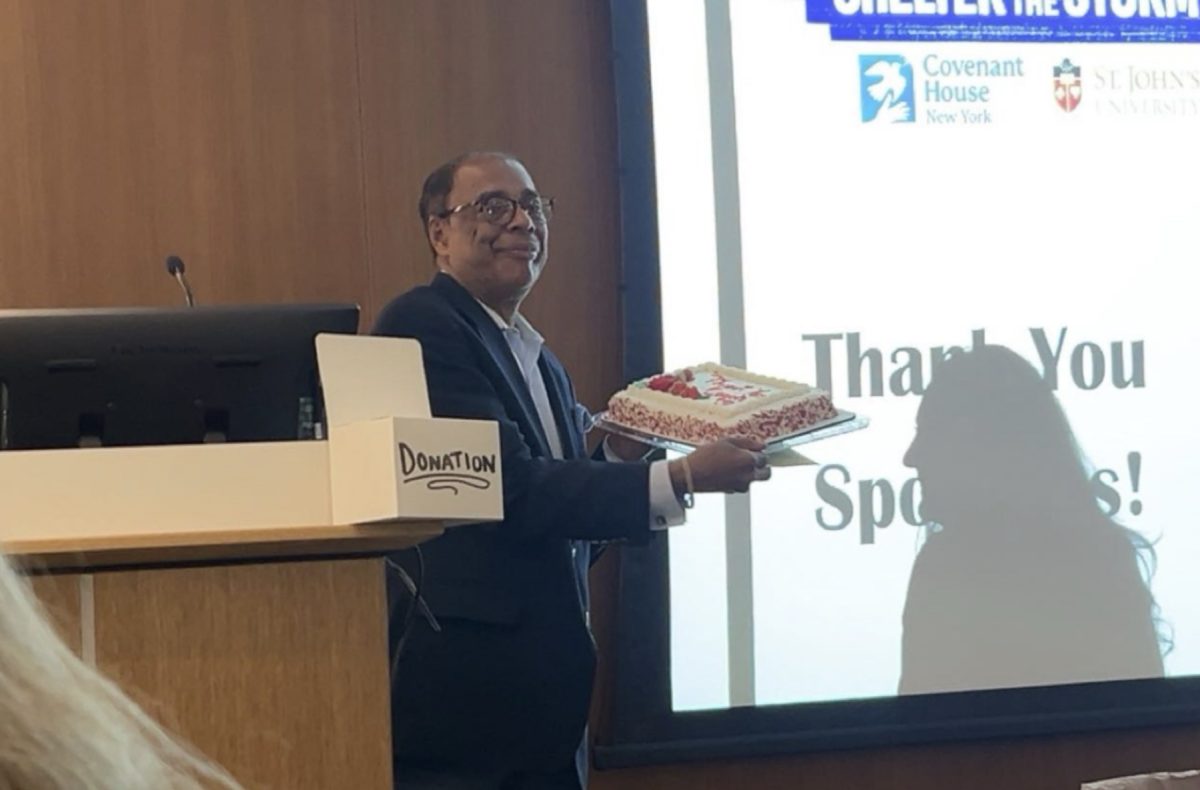
But for Taylor, this campaign was special. Enough so that his students felt compelled to buy him a cake to congratulate him for his work.
“Covenant House has always been close to my heart,” he told The Torch outside the conference room. Moments before the interview, Taylor had been informed that donations had reached $3,100 and were still coming in. Along with the toiletries collected by the initiative, the funds allowed them to reach their goal of $5,000.
A notable point in the event came at the conclusion of Kumbatovic’s story of homelessness. Taylor took to the podium as Kumbatovic returned to her seat. As he began to speak, the professor became visibly emotional.
“You are not invisible,” Taylor said directly to Kumbatovic, sitting in front of him. “We all live in New York, we all walk past people like Christine every day.”
“At the end of the day, you can’t save the world, but you can save one person at a time,” Taylor said, wiping tears from his eyes as he returned to his seat.