







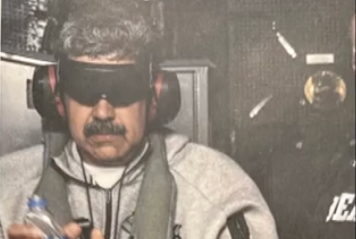
The United States captured Venezuelan President Nicolás Maduro and his wife, Cilia Flores, in a pre-dawn operation in Caracas on Saturday. U.S. officials said the couple was taken on the U.S. warship USS Iwo Jima and later flown to New York, where they are facing drug- and weapons-related charges.
In an indictment, the Justice Department alleged Maduro was at “the forefront” of a drug trafficking operation that transported “thousands of tons of cocaine” to the United States.
The raid followed weeks of escalating pressure on Maduro’s government. On Dec. 16, U.S. President Donald Trump ordered what he called a “total and complete blockade” of sanctioned oil tankers entering or leaving Venezuela, and the Coast Guard later seized tankers.
Trump, speaking at Mar-a-Lago late Saturday morning, said the U.S. would “run the country” until a “safe, proper and judicious transition” could take place. Secretary of State Marco Rubio later clarified that the U.S. would not govern Venezuela, but would continue its quarantine of the country’s oil.
“In terms of other countries that want oil, we’re in the oil business. We’re going to sell it to them,” the President added when questioned about the use of Venezuelan resources.
Maduro’s vice president, Delcy Rodriguez gave a defiant, nationally televised speech that afternoon accusing the U.S. of attempting regime change to capture Venezuelan energy, mineral and natural resources. She also said that Venezuela was ready to defend its resources. Rodriguez was sworn in as interim president on Jan. 5.
“We’re not afraid of boots on the ground,” Trump told reporters, warning of a “much bigger” second wave of attacks if the Venezuelan government refuses to comply.
The operation — dubbed “Operation Absolute Resolve” — came as explosions were reported in and around Caracas around 2 a.m. local time, which knocked out power in parts of the capital, according to Reuters witnesses and reporting. Air Force General and Joint Chiefs Chairman, Dan Caine said the mission had been planned several months in advance.
Reuters reported that Maduro and Flores surrendered inside a heavily guarded residence in Caracas that Trump described as a “fortress,” after an entry team that included U.S. Special Forces and FBI agents raided the location.
Venezuela’s oil production facilities were operating normally after the strike, though the port of La Guaira suffered severe damage, according to Reuters. The news service also published images showing damage at La Carlota (Generalissimo Francisco de Miranda) air base in Caracas, and said strikes took place in Miranda, Aragua and La Guaira states.
Venezuelan Attorney General Tarek William Saab said the bombing campaign caused civilian casualties. The United States has not confirmed casualty figures, although officials have acknowledged some American personnel were injured during the operation, according to Reuters.
The campaign has drawn criticism from foreign leaders. Mexico’s Foreign Ministry condemned the strikes as “a clear violation of Article 2” of the U.N. Charter. Article 2 prevents countries within the U.N. from using force or threats to violate a nation’s territory or political independence. U.N. Secretary General Antonio Guterres agreed that military action violated the organization’s charter.
There has also been backlash from Democratic Party lawmakers on Capitol Hill who are accusing Trump of moving forward with military strikes without Congressional approval.
Maduro is being held at the Metropolitan Detention Center, in Brooklyn, while awaiting trial. Maduro and his wife appeared in a Manhattan federal courtroom on Monday, pleading not guilty to all charges.
The Trump administration suggested on Monday that future military intervention could also take place in Colombia, Cuba, Greenland and Mexico.