









The Big East.
One of college basketball’s mightiest conferences, the Big East has claimed 11 national championships, the fourth most of any league in Division I history. In 2025, the conference remained among the nation’s best, featuring two teams ranked in the AP preseason Top 25 and six programs inside KenPom’s preseason Top-50.
With the ever-changing landscape of college basketball, a quick refresher on where each team stands heading into the upcoming season can help any hoops fan get up to speed. In this piece, you’ll find everything you need to know about each Big East program, plus one key player goal to watch for this season.
UConn
After a disappointing 2024–25 campaign, Dan Hurley and the UConn Huskies are once again expected to be the top dogs of the Big East. The Huskies struggled early last season due to injuries, Liam McNeeley missed several weeks with a high ankle sprain, while Tarris Reed Jr. sat out the start of the year with a hamstring injury. Those early setbacks slowed UConn’s momentum, turning their strong finish into a “too little, too late” story as they fell to Florida in the second round of the NCAA Tournament.
This offseason, UConn lost star forward McNeeley to the NBA Draft, along with key depth pieces Hassan Diarra and Samson Johnson. Hurley addressed those departures by bolstering the roster with Georgia transfer Silas Demary Jr., who also drew interest from St. John’s, and by adding five-star recruit Braylon Mullins, a McDonald’s All-American ranked No. 12 nationally by On3.
With the Huskies entering the season ranked No. 4 in the AP Top 25, Hurley and company are poised to reclaim their place in the national spotlight as one of college basketball’s elite programs.
Solo Ball:
“Just being connected with this team. I feel like we have great chemistry so far just going into the year. We have 10 new guys, but I feel like we’ve known each other for so long.”
St. John’s
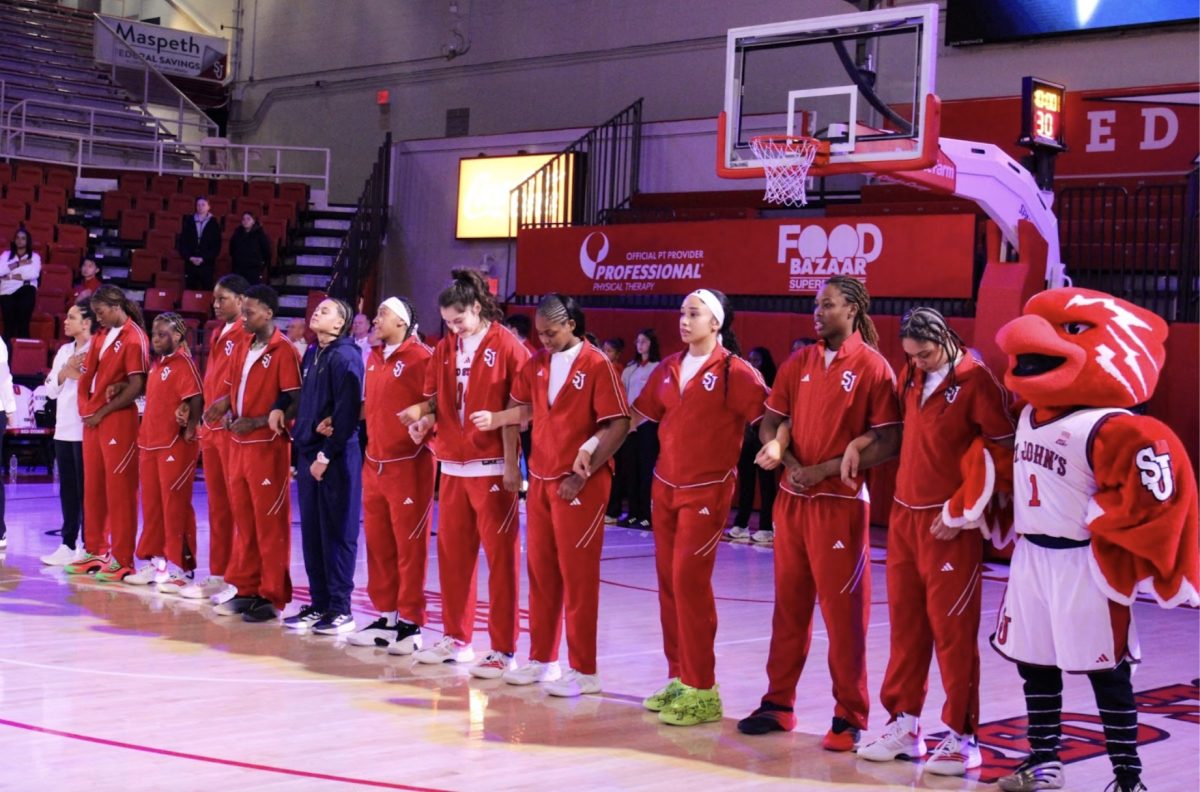
A storm is brewing in Queens, and this time, it’s stronger than ever. Rick Pitino has completely revitalized college basketball in the land of opportunity, leading his program to its first preseason ranking since 1999 and the highest in school history at No. 5.
The Red Storm have every reason to receive this level of hype after winning both the Big East regular season and tournament titles, their first sweep since the 1999–2000 campaign.
Pitino and the Johnnies retained star center Zuby Ejiofor and brought in the nation’s top-ranked transfer class. Losing RJ Luis Jr. leaves a bitter taste after his underwhelming finish, but replacing his production with a player like Ian Jackson is the best-case scenario.
This year’s Red Storm emphasizes offensive improvement while maintaining one of the top defensive units in the country. Joson Sanon is expected to be a major perimeter threat, averaging 11.9 points per game on 37% shooting from beyond the arc last season, while additions like Oziyah Sellers and Dylan Darling further strengthen the team’s scoring depth.
St. John’s has all the tools not only to contend for a national title but to become the true “Don” of the Big East.
Handje Tamba:
“I’m looking to play in a game, it’s been a long time.”
Creighton
The Bluejays carry significant potential to compete with the Huskies and Red Storm, though on a slightly reduced level. Creighton had its chance in 2024–25 to capture its first-ever Big East Tournament title but fell short in the championship game against St. John’s, losing 82–66 after being outscored by 19 points in the second half.
The major setback for Creighton this offseason is the loss of their two stars, Ryan Kalkbrenner and Steven Ashworth, who helped lead the program to the second round of the NCAA Tournament.
The Bluejays were hit hard by the NCAA’s ever-evolving transfer landscape, losing Pop Isaacs and Jamiya Neal to Texas A&M. However, head coach Greg McDermott did an impressive job replenishing the roster, landing Iowa standouts Owen Freeman and Josh Dix, headliners of a transfer class ranked in the top 10 nationally. The Bluejays round out the trio of Big East programs ranked in the AP Top 25 preseason poll, entering at No. 23.
Marquette
The Marquette Golden Eagles enter this season with one major advantage: they’re led by one of the best coaches in the country, Shaka Smart.
Marquette looked dominant early last year, holding firm as one of the nation’s top teams before fading late in the season following a strong surge from St. John’s. The Golden Eagles fell to the Red Storm in the Big East semifinals, 79–63, a game that mirrored their late-season struggles. A week later, their season came to an abrupt end with a 75–66 upset loss to the No. 10 seed New Mexico Aggies.
This offseason, Marquette was quiet in the transfer portal, failing to find a replacement for star guard Kam Jones, a consensus Second-Team All-American and unanimous All-Big East First-Team selection who averaged 19.2 points per game.
The Eagles also lost key contributors David Joplin and Stevie Mitchell. As a result, Smart and his staff will rely heavily on the returning backcourt of Sean Jones and Chase Ross, while banking on internal development to keep Marquette competitive in a loaded Big East.
Shaka Smart:
“Watching our guys out there on the floor, competing, going after winning.”
Providence
Are the Friars back? Kim English faced a tough situation last season, with Providence weighed down by season-ending injuries to Bryce Hopkins and others. The Friars finished 12–20, their first 20-loss season since 1984–85.
Now, with Hopkins joining Big East rival St. John’s, English wasted no time reloading the roster through the transfer portal and a promising freshman class. Providence landed Jason Edwards, a proven scorer who averaged 17 points last season at Vanderbilt, and Duncan Powell from Georgia Tech, who averaged 12.
The Friars have the tools to make a push for March basketball this year, it’ll just come down to how quickly this retooled roster can come together under English.
Jaylin Sellers:
“Just coming out of the gate being able to play. Over the past few years I wasn’t able to play the game of basketball, now I’m excited to just get games under my belt.”
Villanova
It’s a new era in Pennsylvania. Kyle Neptune is out, and the Kevin Willard era has officially begun. Willard, the former head coach at Maryland, led the Terrapins to the Sweet 16 this past season and owns a career record of 335–249. He now returns to the Big East, where he previously spent 12 seasons leading the Seton Hall Pirates.
The Wildcats have undergone a complete roster overhaul this offseason. They’ll lose leading scorer Eric Dixon, along with several other key contributors.
In response, Willard turned to the mid-major market in the transfer portal, landing Bryce Lindsay from James Madison and Duke Brennan from Grand Canyon. Villanova also added highly touted four-star freshman guard Acaden Lewis, ranked No. 31 by On3, who has the potential to make an immediate impact.
The Wildcats likely won’t be a major factor at the top of the Big East standings this season, but with a new coach and system in place, year one under Willard could lay the foundation for a quick turnaround.
Xavier
Richard Pitino is finally stepping into the national spotlight. The son of “The Godfather,” Rick Pitino, will coach the Xavier Musketeers, joining his father in the Big East, where the two will face off twice this season. Pitino brings an up-tempo, high-powered offensive system to Cincinnati, having led the New Mexico Lobos to a Mountain West title and a top-15 offensive finish in 2024.
The Musketeers lost a lot, including head coach Sean Miller, who’s set to take over at Texas, as well as big man Zach Freemantle, Marcus Foster and star guard Ryan Conwell.
Still, Xavier has reloaded with the additions of Tre Carroll and Malik Moore. Xavier is projected to finish in the middle of the Big East pack but could emerge as a legitimate threat if the team quickly adapts to Pitino’s system.
Georgetown
The Hoyas enter year three under Ed Cooley with a renewed sense of hunger and optimism, chasing their first NCAA Tournament appearance since 2021. The trend has steadily gone up for Georgetown in recent years, as the program posted its best record since 2018-19 under Patrick Ewing, finishing 18-16 last season. The Hoyas were a pesky bunch, led by the guard-center duo of Thomas Sorber and Micah Peavy.
With both players heading to the NBA, Cooley knew what it would take to upgrade his roster. Georgetown brought in the guard duo of KJ Lewis and Langston Love, who will join returning standout Malik Mack. Lewis, a former Arizona Wildcat, is best known for his defensive intensity and was a four-star recruit in 2023. The Hoyas also strengthened their frontcourt by adding former St. John’s center Vincent Iwuchukwu. The 7-foot-1 big man brings intriguing upside that was never fully tapped in Queens.
Cooley’s team is built on toughness and execution, the kind of play that translates in March, and this season could be when it all starts to show.
Butler
It’s do-or-die time for the Butler Bulldogs. Head coach Thad Matta has led Butler to a combined 21-39 record through three disappointing seasons, with many viewing this fourth year as a potential “retirement watch” if things go south again.
The Bulldogs are losing key pieces in Jahmyl Telfort and Pierre Brooks II, their top two scorers from last season, as Butler finished seventh in the Big East with 73.1 points per game.
Newcomers Jalen Jackson and Yame Butler are expected to provide significant upgrades in the backcourt, though questions remain in the frontcourt. Butler has a chance to surprise people this season, but there’s no denying the risk that comes with such a drastically reshaped roster.
Michael Ajayi:
“I’m looking forward to playing against the top teams in the conference like St. John’s, Creighton, Marquette, while also trying to have fun each game.”
DePaul
The Blue Demons showed signs of improvement in 2024-25, but can Chris Holtmann’s squad continue that upward trend this season?
There’s no other way to put it: DePaul has been the laughingstock of the Big East, going 19-17 in 2019 and failing to post a record above .500 in each of the past six seasons. The last time the program made the NCAA Tournament? 2003.
Holtmann appears to be breathing new life into DePaul, bringing in much-needed size and floor spacing to address key weaknesses from last year. While the Blue Demons likely won’t be dancing in March anytime soon, it’s encouraging to see a program that has long struggled finally showing signs of life, and giving the conference a bit more competition in the process.
NJ Benson:
“I’m excited to play with the new group we have.”
Seton Hall
The Pirates are trending in the complete opposite direction of DePaul. Once a dominant Big East program, Seton Hall now finds itself near the bottom of the conference. The team was hit hard by the transfer portal in 2024, losing former stars Kadary Richmond and Dre Davis, which left the roster depleted and led to a 7-25 finish.
Seton Hall will return just two players this season, both of whom played limited roles, a clear reflection of the new era of college basketball. The Pirates did land Najai Hines, a 6-foot-10 center ranked No. 72 in the class of 2025, making him the third-highest-rated recruit to sign with Seton Hall since the turn of the century.
Buckle up, it’s shaping up to be a long season for the Pirates, who continue to face the harsh realities of competing with limited resources in today’s college basketball economy.

